Best Of
Re: What are the Advantages/Disadvantages of picking Snowflake vs. Databricks vs. AWS S3?
Snowflake and Databricks are direct competitors to each other, while AWS S3 is a slightly different product. Snowflake and Databricks both offer cloud data warehousing, managed by them, allowing you to focus on the data and not worry about the set up of VMs, managing servers, etc. With Snowflake, you can stick to SQL to build tables, create databases, move data, and create logical structures in the same traditional format you are familiar with. You pay for what you store and pay for what you compute. Use more and pay more. But no facility overhead or infrastructure overhead. I've only ever used Snowflake, but from what I have read, Databricks is considered more technical than snowflake, where you can have a little more control of the processing and compute methods. DB is Spark based IIRC, and Snowflake is really just traditional SQL.
How I understand them, a team that favors SQL writing will do better with Snowflake, and a team that favors righting python Spark jobs will do better with Databricks.
AWS S3 is object storage (storing files). Not a data warehouse by itself. You can use your files in S3 to serve as a source of data that is ingested into your data warehouse, which is very common. I know that Snowflake can easily stage files from S3/GCP Cloud Storage directly into tables in your data warehouse, it's a simple process and can be automated as well.
As far as Domo goes, Domo has cloud amplifier connections that connect directly to your Snowflake or Databricks instance. Connecting the two is straightforward.

Re: Reflections from Domopalooza 2026 and my Case for Cards
Very well said @DavidChurchman and I agree 100% with your comments. I am thankful that product leaders like @BenSchein see these comments and are appreciative and mindful of them. I was encouraged by some of the actual Domo releases that were announced and look forward to them. The Domo visualizations, connectors and ETLs are amazing and so much easier to use than their competitors and I hope that Domo does not lose sight of that.

Re: Reflections from Domopalooza 2026 and my Case for Cards
@DavidChurchman very thoughtful reflection. I agree with much of it and have some context and clarification on other parts including the role Claude can and should play (among other AI tools) and even how that potentially impacts what a card means and is. Ping me at ben.schein@domo.com and can find some time. Likely later in April as I am taking some time to rest later this week.

Reflections from Domopalooza 2026 and my Case for Cards
Last week, I attended my first Domopalooza and I wanted to take a moment to share my reflections. I'd be curious to hear what everyone else took away, so I hope to hear from some of you. My biggest takeaway was how impressed I was by the product managers I got to meet and see present. They seem genuinely engaged with the user community and announced/demoed a host of features that will make my life better in Domo (as they eventually trickle out into GA). More than once, I saw screenshots of posts from this very forum as part of their presentations, showing the demand for the features they built. Also, more than once, and for different features, I heard the claim that a new feature was the "most requested" by the community. That makes me think we could use a better system for merging similar requests and creating a more reliable metric for ranking the "most requested" features.
My second big takeaway was that the Domo community is, in fact, a community. I felt warmly welcomed by everyone, especially those that, like me, spend too much time on this forum. It made me realize I would benefit from putting more of myself into this community. Those two things—that Domo leaders take to heart the posts on this forum and my renewed appreciation for the members of this community—motivated this post (and maybe some more posts in the near future).
Which brings me to my third takeaway from Domapalooza: bookends to the conference that made me think that Domo leaders misunderstand why people use Domo. The opening bookend was a series of breathless demonstrations of the powerful capabilities of…Claude. The demos were (it was proudly declared) prepared at 1:30 am that morning. I'm curious what was pushed off the agenda by that early-morning brainstorm. One can imagine someone had thought about something for more than a few sleepless hours that they were ready to present to the thousands of attendees at their freshest and most excited.
What was the point of the Claude demos? Was the point that Domo's core features are so clumsy that you need to use a different company's robot-god-brain to extract any meaningful value from them? Was the point that none of Domo's own new features were exciting enough to compete with Anthropic, so let's play with the exciting stuff before we have to slog through all the boring Domo stuff the next couple days? They opened with Claude in an apparent vote of no-confidence of Domo.
The closing bookend for me, if not the literal one, was when Domo's CEO reacted with exaggerated dismay to Domo being called a "dashboard company". What's wrong with being a dashboard company? What does a well-made Domo dashboard represent? Useful data has been connected, transformed, and analyzed, and is being put in front of the people that need to see it.
Which brings me back to why (I believe) people use Domo. That process from connecting raw data to presenting it clearly has never been as easy as it is in Domo. That is Domo's competitive advantage. Anything that adds to that ease of use will build on Domo's advantage, and anything that distracts from it is a missed opportunity. The vision laid out in the general sessions started and ended with Claude and some dubious promises of using AI in Domo. Happily in contrast to that vision, when I look at the product announcements from Domo, I think most if not all are building on Domo's ease of use; you don't need to use Claude to benefit from Worksheets or the myriad enhancements in MagicETL. That mismatch between what Domo is saying they're doing and what they're actually doing gives me hope.
What I do see missing is any investment in cards. What was the last new card type we got in Domo? I think it was packed bubbles back in October 2023 almost three years ago? (I'm not counting the minor updates to donuts and gauges in January 2024). Worksheets and the new App Components serve a similar function as cards, so those are welcome and helpful additions, but they don't play across the entire Domo ecosystem the way that cards do.
So I'll close with my case for cards. The card is the atomic unit of analysis in Domo. They determine what can be built with the rest of Domo with the least friction. Wouldn't it be nice to expand the periodic table a bit? I'm not talking about features that can only be used in AppStudio or that you need Claude to help you create in a ProCode app, but cards that my least technical users can make from anywhere in Domo and have a better handle on their data than they did before.
I have some ideas for the types of cards that I'd love to see, and my intention is to post some ideas in the coming weeks making a more specific case for those cards. I hope you upvote some of those ideas and contribute some of your own. I also hope some resources are left at Domo after they pay for all their Anthropic subscriptions to continue to develop the part of Domo that makes Domo what is is: a dashboard company.

Re: Reflections from Domopalooza 2026 and my Case for Cards
Great stuff David. Thanks for sharing and writing a thoughful response. Totally agree on the community. It was AMAZING to meet all of y'all in person. I think this is an important asset to DOMO and they would be remiss to neglect, abuse, ignore, or otherwise undermine the strength of this community. I'm not saying they are - but one thing DOMO has that other's do not is us :)
I agree on the sentiment regarding Claude use within DOMO. The start of the conference felt like an un-skippable ad for Claude, and I know a few others I spoke to felt this way too. Are we here for DOMO or are we here for Claude? None of what got presented needed DOMO to succeed - the "native" visualization within the Claude interface was the hero presented on the foundation of the Claude coding engine. While tremendously impressive and amazing, this had nothing to do with DOMO…
Plus, and perhaps most importantly, it was never actually taught HOW to get Claude to work in DOMO. There's a lot that has to happen between having data in DOMO to having Claude actually work in your environment.
I didn't receive the CEO's closing comment in the same light as you. I received it more optimistically, as if he were to say "Yes, we make dashboards, but we are so much more than just building dashboards! We also have MagicETL, and robust governance, and XYZ….." That being said, I do agree with your sentiment: a dashboard in it's most purest form is a dance of governance and clean data and optimized ETLs and smart charting and thoughtful plating and optimized UX and etc. etc. etc. But I don't think Josh James took it that way.
Excited to see what everyone says,

🚨NEW Features Now Live in Domo!
Among all of the Domopalooza fun, we just dropped new features and enhancements that are live today!
Here is a taste of the top new features:
- Nav Configs – Create customized navigation that guides every user straight to the content that matters most for their role.
- Worksheets – A spreadsheet-like space for ad-hoc analysis, so anyone can explore data and find insights without building a full dashboard first.
- App Studio Editor – Faster app development with improvements like bulk saving and undo/redo built right in.
- Workflows as Tools in Agent Task – Turn existing workflows into reusable tools for AI agents and scale automation more efficiently.
- Pro Code Components – Major API updates that let app components communicate directly and tap into device features like camera and geolocation.
Bonus: Slicer Cards + Variable Linking make dashboards and apps even more interactive and dynamic.
Below is the FULL Domopalooza 2026 product feature overview:
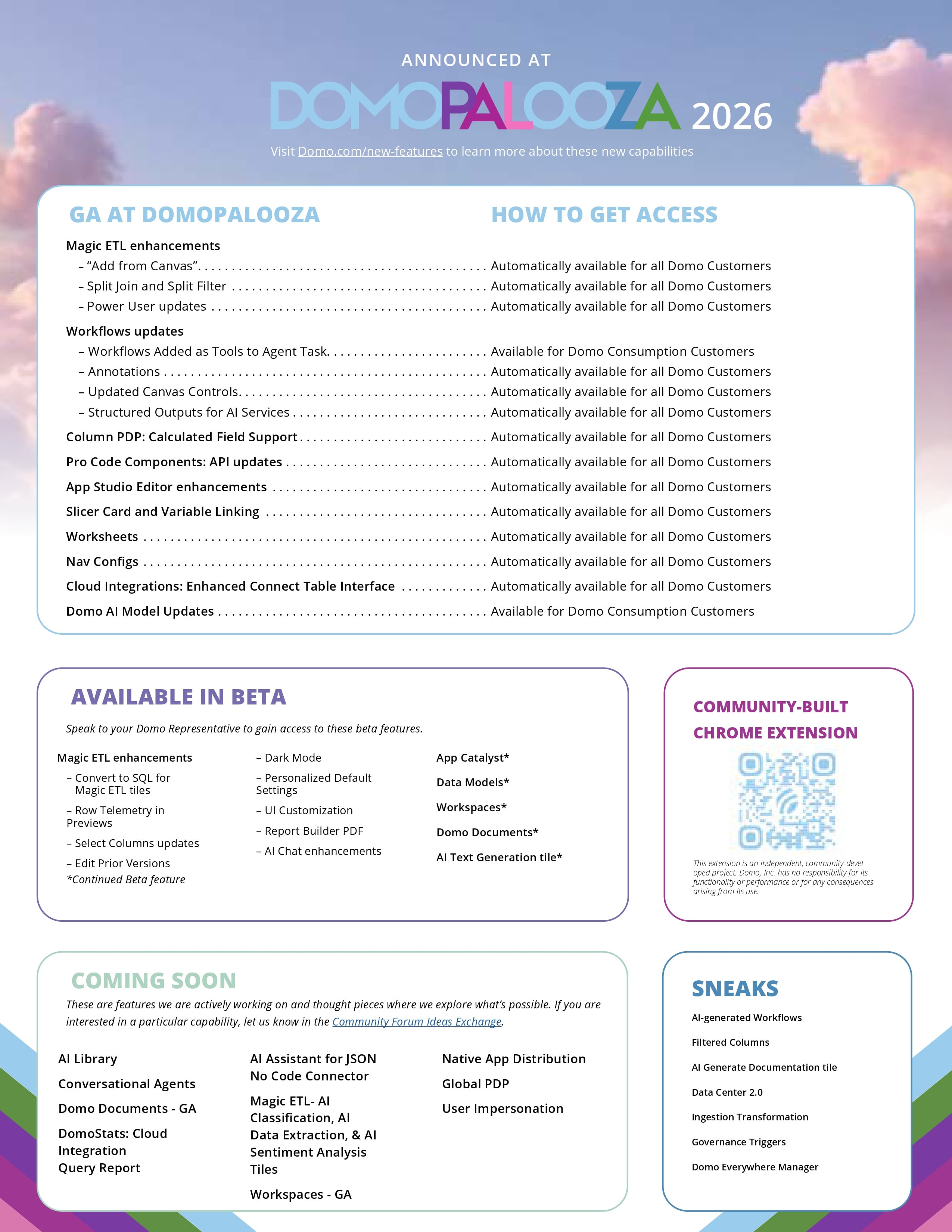
To see all past, present, and future feature releases, check out our product release page and the Domo Drop playlist on YouTube.

Re: Lag to set a forecast
The first thing you need to do is convert your factors table into a compound factors table. So if your table looks like:
Jan 1 2026, 1.0
Feb 1 2026, 0.8
Mar 1 2026, 0.7
Apr 1 2026, 1.2
We're going to make it look like this:
Jan 1 2026, 1.0
Feb 1 2026, 0.8
Mar 1 2026, 0.56
Apr 1 2026, 0.6720
All the factors are written in terms of the cumulative factor since the start of the table. That way to get the factor between two points in the table, we just need to take the target month factor and divide it by the actual month factor: Predicting April based on February becomes 0.672/0.8 = 0.84 (which is the same as 0.7*1.2).
Unfortunately, cumulative product is not a function in Magic or indeed in most SQL dialects. Cumulative SUM(), sure, but there's not PRODUCT(). But there's a trick we can use to do it with SUM() by using logarithms:SELECT *, EXP(SUM(LN(`Factor`)) OVER (ORDER BY `Month`)) AS `Cumulative Factor` FROM `Assumptions`;
(Note that you can do this with three tiles instead of the SQL tile if you want: Add Formula (for the LN) → Rank & Window (for the cumulative sum) → Add Formula (for the EXP).)
Now all that remains is to select the row you want to use for prediction. It sounded like you wanted the most recent row that has actual data. Pick that row using either an Order → Limit or SQL. Then inner join that row to the cumulative factors table on the month, keeping only the cumulative factor column from that side of the join and renaming it to Base Factor. Then join that result onto the cumulative factors table again, this time using CumulativeFactor.Month > Source.Month as the join expression. Now you have a table containing all the information you need for your projections: The actual value from the most recent data point and the base factor for that month, both repeated in every row, and then the cumulative factor for every month thereafter. Now you just add this formua:Actuals*(CumulativeFactor/BaseFactor)
To get your predicted value for all the future months.
 rco
✨ Domo Brilliance Bar ✨ Expert Support at Your Fingertips

Whether you have an existing support ticket or need additional guidance with your specific use case, book a 30-minute session with our Domo experts during the conference. Think of it as your personal tech bar—where you can walk up with any Domo challenge, and our team provides white-glove service to get you unstuck. Our experts are ready to provide hands-on troubleshooting with connecting data, Beast Mode guidance, and other technical challenges.
The ACE (Advanced Customer Enablement) Program provides your organization with a dedicated technical agent and customized strategies tailored to your specific needs, ensuring you maximize your Domo investment.
Re: January & February Community Forum Recap
I expect everyone to swing by the Community booth to learn our new handshake 😂
Re: January & February Community Forum Recap
@GrantStowell This is awesome! I’m really looking forward to connecting with so many of our community members at Domopalooza this year. Right now, nearly 40% of registrants are from the Domo Community, that's impressive.
It’s shaping up to be another great Domopalooza!
 tjoyarz