Best Of
Major Meet-ups! | Domo Connections Tour Coming to 10 Cities

Domo Connections Tour: Let’s Meet Up IRL
One of the coolest things I've enjoyed about the Domo Community is connecting with other Domo users. This fall, we have 10 chances to do that in person as the Domo Connections Tour comes to cities across the U.S. and Canada.
These free events include:
- Technical sessions with Domo experts to help you get more out of Domo
- Customer panels featuring real-world Domo successes and lessons learned
- Open networking time to meet other Domo users, swap ideas, and compare notes
Whether you’re a longtime Domo pro or newer to the platform, it’s a great opportunity to step away from the screen and connect with people in the community who are working with Domo just like you are.
Here's the list of the 10 metro-area stops to choose from:
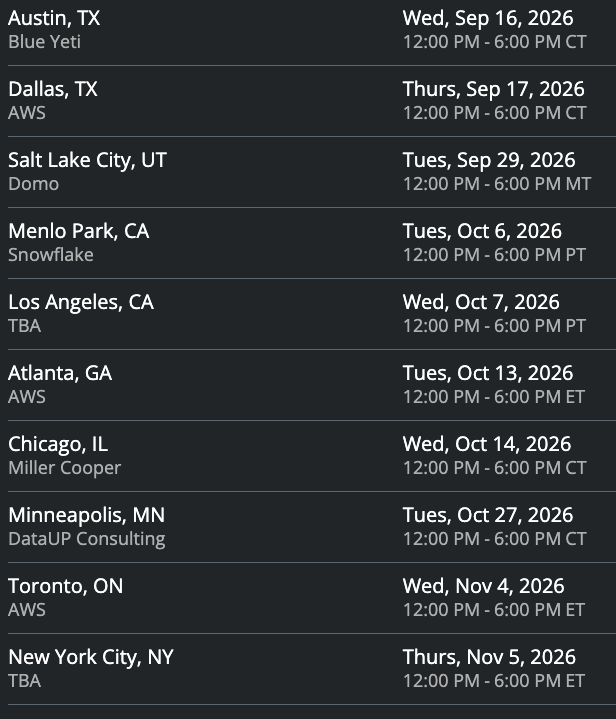
If you’re planning to attend, let me know in the comments which stop will you be at?

Re: Did an Update Break Window Functions in MAGIC?
It looks like there was an underlying database version upgrade that caused this issue. The team is working to roll back that update, which should be completed by EOD.

Re: Did an Update Break Window Functions in MAGIC?
Hi all - I've brought this to the engineering squad and we're reviewing whether any changes were made that could have resulted in this. I'll update you when I learn more. Thanks for surfacing this!
Re: Did an Update Break Window Functions in MAGIC?
Haha, I started the thread 3 months ago.
I can pinpoint the time of error to between 4:45PM and 5PM on 2026-09-15 as I was actively creating a new ETL with a SQL window function.

Did an Update Break Window Functions in MAGIC?
I have a long-running ETL with a window function in a SQL tile that is throwing the dreaded 'unknown error occurred' as of this morning. The function looks like this:
CASE WHEN MIN(t.`Arrears`) OVER (PARTITION BY t.`Customer`) > 360
THEN 1
ELSE 0
END AS `360 Flag`
Re: What are YOU working on?
Thanks @CamBarnes Yep very happy to inspire and educate the community. As for governance with some clients, I'm seeing that people aren't seeing it as a big deal as of now, but I think it's a longer term issue that kind of should be addressed sooner rather than later. I'm just here preaching the ways of governance.

Re: Filtering on NULL or empty-string values
Agreed. I would recommend upvoting some of the idea exchanges that have been submitted around this topic. Here is one you can upvote:
https://community-forums.domo.com/main/discussion/68606/filtering-on-missing-null-values-is-awful-improve-it?utm_source=community-search&utm_medium=organic-search&utm_term=filter+on+null

Re: Pivot Table
oof anti patterns! (imho)
i know Domo's row based consumption pricing makes things tough, but I (and ralph kimball) are proponents of UNION'ing fact tables not JOINING pre-aggregated data onto the same row — the model that @DavidChurchman is promoting.
TBF a lot of reports from APIs DO take that format b/c it's an easy shape to create and conservative on row count (just one row at the granularity of date, or date and department etc.
You do need to be careful about how you represent no data rows (what happens if there were no sales in August, if you're using that JOIN strategy then you have no row.
my UNION strategy doesn't address "what happens if there are zero rows" but it does maintain the ability to drill down at the row level!

Re: Line + Grouped Bar chart auto-scales bar axis too high
This is occurring because it needs to make the same number of segments as the line side. Since your line side is broken up into 4 segments (0,10,20,30), it needs to break up the bar side into 4 segments.
I had a similar chart that had percentage as the line and currency as the bar and initially ran into the same issue you were facing. I adjusted the starting percentage of my line to be something greater than zero and then the line moves down and the bar scale recalculates to different amounts and displays much better. The Min amount can be found in the Value Scale (Line) chart property.
Another option is to try different Max Gridlines. This is also found in the Value Scale (Line) chart property.
Re: Pivot Table
You won't be able to pivot the data in that specific format because the columns would show your QTY or Sales based on the FY and Branch and not separate.
You'd need separate pivot tables, one for sales and one for quantity.
If you have a small, limited, and non-changing list of branches or fiscal years, you can use a conditional sum in Beast Mode to calculate each column individually.
-- Branch A Qty
SUM(CASE WHEN `Branch` = 'A' THEN `QTY` END)
-- Branch B Qty
SUM(CASE WHEN `Branch` = 'B' THEN `QTY` END)
-- FY 2025 Sales
SUM(CASE WHEN `FY` = 2025 THEN `Sales` END)
-- FY 2026 Sales
SUM(CASE WHEN `FY` = 2026 THEN `Sales` END)
You'll need to create new beast modes every time a new Branch or Fiscal Year appears in the dataset.